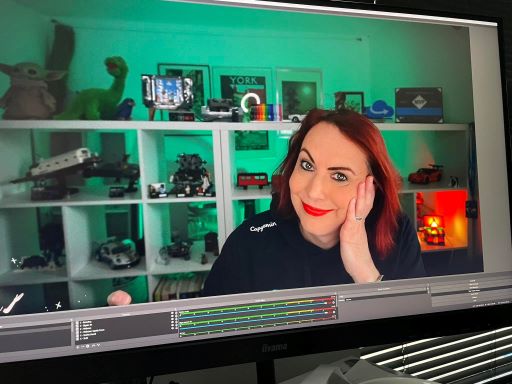
Stacy Cashmore
Stacy Cashmore
Speaker, author and software developer. Stacy has been developing solutions since the mid-1990s in various companies and industries ranging from facilitating contract jobbing to allowing consumers to close a mortgage without the help of a financial adviser - with lots in between.
She has a passion for sharing knowledge: using story telling for sharing her experiences to help teams grow in the ways that they develop software and work together, and performing live coding demonstrations to inspire others to try new technologies.
In 2022 Stacy published her first book, aimed at helping developers get started building dynamic applications using C#, Azure Functions and Azure Static Web Apps. In February 2026, she released the second edition, updated for .NET 9 and with added infrastructure as code content to help readers apply what they've learned in real-world scenarios.
Stacy is driven, in both daily work and in the community, by the feeling she gets when she sees teams improve. The smile on their faces when they enjoy what they're doing more. Removing real frustrations to make daily tasks genuinely enjoyable.
For her effort in the community Stacy has been awarded the Microsoft MVP for Developer Technologies since 2020.
My Talks
SessionizeSelf care in a world of anxiety
Suffereing from panic attacks made attending meetups and conferences very painful for me. A massive anxiety attack on day one of Techmorama NL in 2018 left me exhausted and wondering if I was going to make it to day 2. But by finding something that I could use to override that memory I did manage to come back! And led to a sequence of events that led me to start public speaking. But... Everyone's experiences, and coping mechanism, are different. In this open space we'll be sharing those experiences, those coping mechanisms with each other and at the same time start normalising this type of conversation for the future!
Testing First - Getting The How
"But how can I test first when I dont't know what I am going to write?" How many times have we heard this statement when we are trying to encourage individuals and teams to test first? In this session Stacy is going to look at what can happen in these scenarios, and the problems that can happen when working this way using a couple of real world examples. Rounding off the session she'll go through a project looking at how to add the testing from the start - and show the benefits it can bring when changes are requested of the code!
What Has Public Speaking Ever Done For Us?
Putting together a conference talk, even a 5 minute lightning talk, takes a lot of time and effort. Hours, days, weeks can be poured into making sure that the talk goes as smoothly as possible. To make sure that as a presenter you know your stuff, but not that it’s an over practiced, robotic delivery. And that’s before you factor in the time and effort in traveling. So… Why do we do it? What has public speaking ever done for us. Let’s find out!
From Panic Attacks to Public Speaking - My Journey
Techorama came to the Netherlands for the first time in 2018. The biggest .Net conference in the Netherlands with a host of amazing speakers! Suffering from severe anxiety it was going to be a tough couple of days, but still, I wanted to go! This is a story about how a panic attack on day one of the conference, followed by a couple of chance meetings lead me to overcome my fear of flying, travelling and people to speak at my first conference.
Developers and Testers: The Yin and Yang of Software Development
Before us, our heroes: Developer and Tester - locked in a gruesome battle for the ages. Both desire the ultimate goal of high-quality, well-functioning software. Why do they wage this war against one another? Will one reign supreme?? Will they meet their release timeline??? Tune in as part of the audience to hear the epic conclusion! This is a common story in software development. At least, that's what some people say. To that sentiment, we say it doesn't have to be like this. There are opportunities for each role to shine, and capacity to consider the risks that concern both parties. Through personal stories from both the good and the ugly, we will share small experiments with you that you can take back to your team. With a little mindful communication, a sprinkle of grace, and a healthy helping of transparency, you can initiate the change you want to see on your team, to encourage more effective collaboration. Together Karen (tester) and Stacy (developer) will tell stories where things went wrong, as well as examples where things went smothly They'll talk about how to improve the collaboration between the 2 roles And also give concrete ideas for attendees to implement when they return to their teams
Refinement-First Processes for AI Development
"Yeah, yeah, but your scientists were so preoccupied with whether or not they could, that they didn't stop to think if they should." — Dr Ian Malcolm, Jurassic Park True in 1993. True today. When developers boast about writing 37,000 lines of code in a day, the question that matters isn't "how much code did you write?" — it's "what problem did any of it solve?" Our job as developers is to solve problems, and volume without value is wasteful. To deliver high-quality code that actually solves the right problem, teams must shift from thoughtlessly generating code to a structured, refinement-first approach. To scale this standard across an entire department, we built a two-stage process: refinement first, build second. Refinement takes a problem through hypotheses, an epic, features, and stories — each with its own prompt specialized to the task. And all before a line of code exists. The prompts are passed to a set of specialized AI agents in Claude Code or Copilot for building, orchestrated with OpenSpec. In building there are also multiple agents that between them handle: architecture, API design, writing tests, reviewing tests, coding, documentation, or logging architectural decisions. And all this in a development environment designed to allow teams to work without interruptions – YOLO mode, safely. This isn't the one true process; it's what works for us, refined through trial and error. Yours will look different. But the basics of it - refine before you build, and let AI specialise rather than generalise - will be a great base to start from. In this session I'll walk the process end to end, showing the real artifacts it produces at each stage: the prompts, the cost of running it this way, and the times it's gone wrong and needed rework. By the end, you'll have a concrete process you can adapt: how to structure refinement so AI doesn't just generate code, but high-quality code that solves the right problem — and an honest account of what it costs to run this way.
You've Got Notifications? Real-Time Messaging for SPAs on Azure
Single page applications are fast, responsive, and require very little backend power — perfect for web-based interactive applications. But unlike connected frameworks like Blazor Web Apps, they have no direct channel to receive updates from the server, meaning your users don't know anything has changed until they refresh. Real-time push notifications should be easy to set up, lightweight to run, and simple to reason about. Azure Web PubSub delivers exactly that — instant server-to-client messaging, narrow or broadcast, with filtering rules to ensure messages only go where they should. In this session we'll build and demo it live together, then apply the same pattern to a real-world scenario and give you a clear framework for when this is the right tool for the job. Bring your phone. You're part of the demo.
Beyond Chatbots: Bad AI Is Worse Than No AI
Adding AI isn't the answer if you haven't found the problem yet. And right now, we're adding a lot of AI without asking nearly enough questions. We'll start somewhere unexpected — the humble date field — and use it to unpick why so many AI implementations frustrate rather than delight. Because the problem is rarely the AI itself. It's the thinking that happened before anyone wrote a line of code. We'll go back to thinking about the problem itself — and build something that makes our users truly joyful, not something to make marketing smile.
Be Authentic with Blazor and Entra ID
Entra ID and Blazor. Both being Microsoft Technologies it should an auth partnership made in heaven. Unfortunately, more than often that is not the case. From the complexity of setting up, to ensuring the correct values are in the application. There are Blazor experts that avoid this in favor of 3rd party solutions. It doesn't have to be that way. By walking through the traps I fell into and setting up a live application — mistakes included — you'll leave with the knowledge and confidence to implement it yourself. Together we'll set up an Entra App for authentication, as well as a separate app for downstream authentication. Then we set up a Blazor Web App, including a minimal API, as well as a seperate minimal API app acting as that downstream API we need to authenticate against. Whether you need to control access for internal or external users, Entra ID, RBAC, and Blazor work beautifully together. Consider this your shortcut — leave empowered to implement it yourself, war stories optional.
How to really work as a team - from sleepy to strong pair programming
So many people think that pair programming is a boring waste of time and effort. I'm here to explain how our team made it work, and what benefits we got out of it! I love working in a team, bouncing ideas off each other and using our combined strengths to produce something that as individuals we wouldn't be able to come up with. One way I like to do this is pair programming. But, when I talk to people about this, I often get told it's a waste of time. That it’s about one person working hard whilst the other looks on, superfluous to the process. And let's face it, most of us have experienced this when trying it out! But I’m going to show you how we went from this sleepy type of pair programming to being super productive when working with multiple developers at one machine! Not the one person working, one person staring into space type of pair programming, but actually providing value to each other, making the extra effort worthwhile, and bringing extra benefits to the team as a whole.
Embrace the pitfalls (Our stop start journey to Change)
As developers, we want to work in a modern way, to get fast feedback on what we are building to make sure that we are building the right things in the right way. However, many companies are still at the start of their journey. Things take longer than we would like to get moving, sometimes change can seem to happen at a glacial pace and whilst you are ready to try and run, others are finding their feet - or even digging in their heels! In this talk, Stacy will go over some of the pitfalls that have happened to her, and the lessons that she has learned from them. Unfortunately, there are no magic solutions to make the problems go away, but hopefully, you can look at the mistakes she has made and go away to make your own new ones to learn from!